Introduction
Most people know what digital marketing is.
Some people even know types of digital marketing.
But very few people actually understand how digital marketing works in real life, step by step.
They see ads, websites, reels, emails — but the system behind it is not clear.
In this blog, we’ll explain the complete digital marketing process, exactly how it works from the first click to final conversion — in simple English, without jargon.
Step 1: Understanding the Business & Goal
Digital marketing never starts with ads.
It starts with clarity.
Before doing anything, we must understand:
- What does the business sell?
- Who is the ideal customer?
- What is the main goal? (Leads, sales, brand awareness)
Example
A local service business needs qualified leads,
while an e-commerce brand needs sales and repeat customers.
Different goals → different strategy.
Step 2: Identifying the Target Audience
Marketing fails when it talks to everyone.
Successful digital marketing clearly defines:
- Age group
- Location
- Problems
- Online behavior
Example
A beginner digital marketing course should talk to:
- Students
- Job seekers
- Career switchers
Not to corporate CEOs.
When you know who you are talking to, messaging becomes powerful.
Step 3: Choosing the Right Platforms
Not every business needs to be everywhere.
Digital marketing works best when you choose platforms based on:
- Where your audience spends time
- What kind of content they consume
Examples
- Google Search → high intent users
- Instagram Reels → attention & awareness
- YouTube → education & trust
- Email → relationship & retention
Right platform selection saves money and effort.
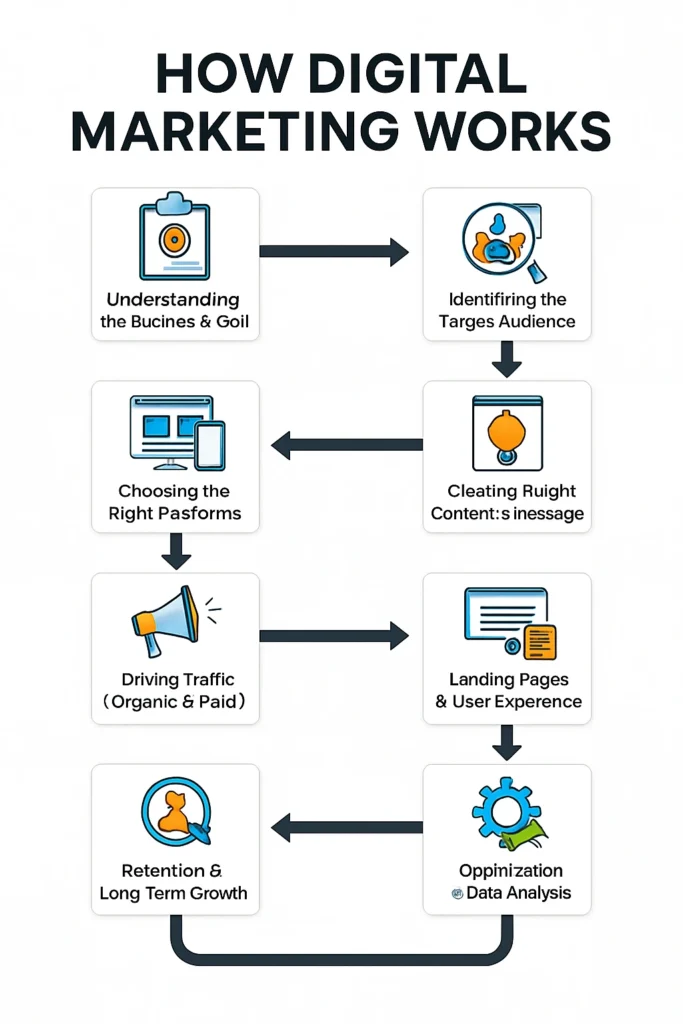
Step 4: Creating the Right Content & Message
Content is not about looking cool.
It’s about solving problems.
Good digital marketing content:
- Educates
- Builds trust
- Answers questions
- Removes confusion
Example
A blog that explains digital marketing clearly builds more trust than an aggressive sales ad.
This is where content + psychology work together.
Step 5: Driving Traffic (Organic & Paid)
Once content and platforms are ready, traffic is driven using:
- SEO (organic traffic)
- Paid ads (Google, Meta, YouTube)
- Social media distribution
Important Truth
Traffic alone doesn’t create results.
Wrong traffic = wasted effort.
Quality matters more than quantity.
Step 6: Landing Pages & User Experience
Where traffic lands decides everything.
A good landing page:
- Loads fast
- Is mobile-friendly
- Has clear messaging
- Guides the user toward action
Example
If someone clicks an ad for “Free Strategy Call”
and lands on a confusing page — conversion drops.
This step is often ignored, but it’s critical.
Step 7: Conversion (Leads or Sales)
This is where results happen.
Conversions can be:
- Form submissions
- Call bookings
- Purchases
- Sign-ups
Digital marketing success is measured here — not by likes or views.
Step 8: Tracking & Data Analysis
If you don’t track, you guess.
If you guess, you lose money.
Tracking helps understand:
- Which channel works
- Which ad performs best
- Where users drop off
Data-driven decisions separate professionals from beginners.
Step 9: Optimization & Scaling
Digital marketing is never “done”.
Based on data:
- Weak parts are improved
- Strong parts are scaled
- Budgets are optimized
Small improvements here can lead to massive growth over time.
Step 10: Retention & Long-Term Growth
Real businesses grow from repeat customers.
This is done using:
- Email marketing
- WhatsApp automation
- Value-based content
Retention reduces costs and increases profitability.
Final Thoughts
Digital marketing is not magic.
It is a systematic process.
When done correctly:
- It attracts the right people
- Builds trust
- Generates predictable growth
At DigiWebSutra, we focus on building these systems — not random tactics — so businesses grow with clarity and confidence.
In the next blog, we’ll discuss Digital Marketing Skills You Must Learn in 2026 to stay future-ready.